Start with clarity
Turn a vague goal into a practical, achievable project plan.

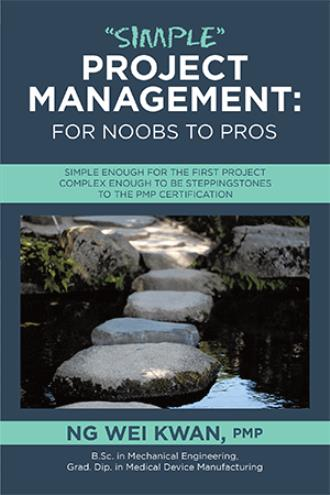
Simple Enough for the First Project. Complex Enough to be Steppingstones to the PMP Certification.

Time or Project?
We have been told since young by others that in order to do something well, we need to have good time management. As one who leads projects for a living who knows a thing or two about this, I will say that time management is a fallacy.
Purely speaking, time management (just like managing people) refers to managing time in which we control time, i.e. we can accelerate it (to make it go faster), slow it down, or to stop time. We can do this with a lot of things but we cannot manage time — it continues to chug along, whether we like it or not. If you were to ask me the time and my answer is, say 9:00am, that time is already gone because it is 9:01am when you continue with what you are doing. Time is like a freight train or a subway that we can only latch on to and hope we can do things within the allotted time. Ask the student who needs to submit the paper at 11:59pm Sunday night or the employee who need to submit the report Mon morning 9:00am.
In truth, what time management really refers to, is Project Management.

A friendly, practical guide for anyone who has been handed a project and wondered where to begin. It translates PMBOK processes into work you can actually use.
Simple Enough for the First Project. Complex Enough to be Steppingstones to the PMP Certification.
Project Management is the discipline of initiating, planning, executing, and controlling complex projects to achieve goals and objectives. Project Managers are responsible for leading teams, managing resources, communicating with stakeholders, and delivering quality results on time and within budget. Project Management books are guides to successfully steer initiatives in various domains and industries and cover topics such as work breakdown structures, stakeholder communication, scheduling, team management, etc.
If the above scares you…well, you are not alone! For some reason, the industry has elevated Project Management to a level somewhat daunting to the average person. This is especially so for high-school students to fresh graduates assigned to do their first project.
Seriously, while nice to have, a PMP or a Master’s in Project Management (just like MBA for businesses) is not essential. Simple Project Management: For Noobs to Pros is a guide for the person who has little or no experience in project management to start a project. While it does use the process from the PMBOK, the goal is to make it simple enough for the first project and complex enough to be used as steppingstones to obtaining the PMP certification.
Turn a vague goal into a practical, achievable project plan.
Build momentum, communicate well, and keep people aligned.
Use a simple foundation that can carry you toward PMP certification.
Practical tools and insights to help you manage projects with confidence.
Why Do Most Projects Fail?
Hover to see answer →
Weak planning, unclear goals, and poor communication. Learn how to avoid these mistakes with structured project management.
What's the Most Important Skill for a Project Manager?
Hover to see answer →
Leadership! A strong PM motivates teams, resolves conflicts, and keeps projects on track. Learn leadership strategies inside.
Want to Manage Projects Like a Pro?
Hover to see answer →
This book simplifies project management, helping you lead successful projects from start to finish—even as a beginner!
Order A Copy Now →
Engineering
A foundation in analytical thinking and problem solving.
Specialization
Experience in a disciplined, regulated environment where details matter.
Practice
A career spent helping teams turn complex work into tangible results.
Certification
Professional rigor paired with a belief that good practice can still be approachable.
About the author
Ng Wei Kwan (the last name is written first) is Program/Project Manager at Agilent Technologies Singapore. His day job is as Program Manager where he manages the New Product Introduction (NPI) programs for the QTOF LC/MS instruments, as well as the Ion Mobility LC/MS. His other (smaller) projects include leading the “Made in China 2025” initiative in collaboration with the Agilent Shanghai plant, manufacturing lead for China OEM LC/MS instruments, and supervising the production of Gas Chromatograph (GC) mainframes. He also serves as the Design for Manufacturing (DFM) lead as well as Eco (Sustainability) Champion for the Singapore site, plus conducting classes for Project Management.
Prior to joining Agilent, he worked at Heraeus as section manager after a successful setup of the Spark Plasma Sinter (power metallurgy) for manufacturing of Ruthenium sputtering targets, Hewlett Packard as NPI lead and product engineer, and OrcaDesign — a 3rd party design-house where he worked on Motorola pagers and Whirlpool air-conditioners.
He received his B.Sc. in Mechanical Engineering from Iowa State University and the Graduate Diploma in Medical Device Manufacturing from the Singapore Institute of Manufacturing Technology (SIMTech). He received his PMP certification in 2014.
Wei Kwan has been married for over twenty-two years with two kids.
If asked, he would say that his greatest project is guiding (together with his wife) both his kids through the competitive Singapore education system: from getting into the Gifted Education Program to attending Raffles Institution and obtaining straight As in the Singapore-Cambridge GCE “A” levels — with offers from National University of Singapore, Waseda, University College and Imperial College. He is working on a book to share his journey (for interested parents).
Also by the author
A Parent’s Guide to Getting Your Child to Imperial College London and Other Top Universities
A candid, long-term roadmap from a parent who has been there—from infancy to university offers. Theophilus Huang shares two decades of real experience raising children in Singapore’s competitive education system. Practical, heartfelt, and full of hard-won wisdom.
Learn more →Featured Podcast Appearance
Listen to Wei Kwan Ng, PMP, on The AEC Project Management Podcast!
Wei recently shared his insights on leadership, project management success factors, and the importance of collaboration on The AEC Project Management Podcast.
Episode Title: Powerful Project Management Success Factors That Will Empower You

Many projects fail due to weak business cases, lack of stakeholder involvement, poor planning, and unrealistic expectations. This book identifies these common pitfalls and provides a structured, step-by-step approach to project management, from initiation to execution and closure. It equips beginners with practical tools and real-world insights to enhance project success rates, making it an essential guide for those managing projects for the first time or seeking to improve their approach.
A successful project manager needs strong leadership, communication, and problem-solving skills. This book emphasizes essential skills such as team building, stakeholder management, decision-making, negotiation, and conflict resolution. It also highlights the importance of emotional intelligence (EQ) and adaptability, ensuring project managers can navigate challenges effectively and lead teams toward successful project completion.
By applying the principles in this book, readers can build experience, manage projects with confidence, and enhance their credentials for career growth in project management. It simplifies complex project management concepts and aligns with industry standards like the PMBOK, making it a practical stepping stone for both beginners and aspiring PMP candidates.
Have a question about the book, a speaking engagement, or project management? Send a message.